


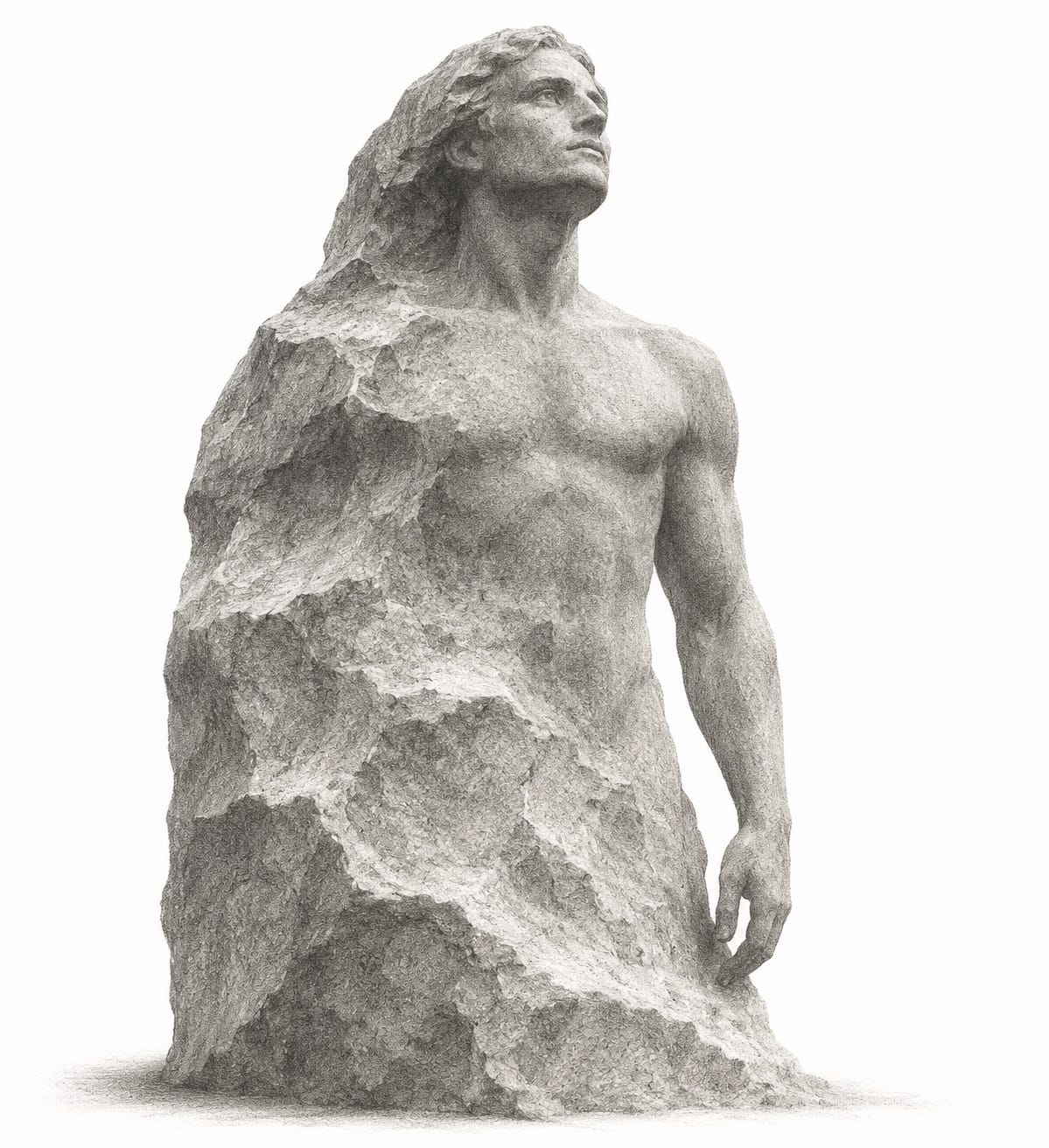
From Gilgamesh to Finding “I”
The oldest journey
More than four thousand years ago, somewhere within the emerging civilisations of Mesopotamia, a story began to take shape. Passed between generations, languages and cultures, it eventually became known as the Epic of Gilgamesh.
Its central character is a powerful king, possessed of extraordinary capabilities but governed largely by his own desires, ambitions and sense of importance. His strength is accompanied by arrogance, his determination by an unwillingness to recognise limitations, and his achievements by an underlying vulnerability that he has yet to understand.
Through friendship, loss, suffering and exploration, Gilgamesh is gradually confronted with the limitations of his existence. His pursuit of immortality takes him far beyond the familiar boundaries of his world, only to return him to the place from which he began.
He has not achieved what he originally set out to achieve. Yet something has changed.
The world to which he returns is largely the same. His relationship with it is not.
Centuries later, similar characteristics would emerge in the Greek epics of the Iliad and the Odyssey. Pride, temptation, anger, grief, determination, compassion and the struggle to find one’s place within existence appear repeatedly throughout these stories.
Whether these narratives influenced one another directly is perhaps less important than what they collectively reveal about the human beings who created them.
Long before the emergence of psychology, neuroscience or behavioural science, humanity was already observing itself.
The greater “Why”
The emergence of civilisation brought with it an increasingly sophisticated attempt to understand existence.
Early human societies observed the movement of the heavens, the changing seasons, the fertility of the land and the unpredictable occurrence of suffering and destruction. Patterns became recognisable, relationships were established and explanations gradually emerged.
These explanations developed into belief systems. As those belief systems acquired coherence, they also began to influence how people lived, behaved and organised themselves.
An understanding of existence became a corresponding way of participating in it.
Across the civilisations of Mesopotamia, Egypt, Persia, Greece and Rome, stories, traditions and explanations were exchanged, adapted and accumulated. Political structures, religious beliefs and observations of human behaviour became ingredients in an enormous and continuously evolving cultural cauldron.
The emergence of Judaism, Christianity and Islam can, in part, be understood within this wider historical landscape, alongside their own distinctive origins, traditions and theological developments.
Humanity was attempting to establish order within the unknown.
Thousands of years later, equipped with telescopes, quantum physics, neuroscience and artificial intelligence, we continue to undertake a remarkably similar activity.
Our instruments have changed. Our curiosity has not.
Each new discovery provides some degree of understanding while frequently revealing further complexity. We establish order, explore beyond its boundaries and encounter new questions that require us to reconsider what we previously understood.
Perhaps understanding is not something we ultimately acquire, but something in which we continuously participate.
Recovery may be understood in much the same way.
When the familiar order collapses
Addiction rarely begins as a conscious decision to become dependent upon a substance or behaviour.
More frequently, something is discovered that appears to fulfil a purpose. It may provide relief from anxiety, emotional discomfort, loneliness, insecurity or an otherwise difficult relationship with existence. It may offer pleasure, confidence, belonging or a temporary suspension of unwanted thoughts.
Whatever its original function, repetition gradually establishes a relationship.
What initially appears to provide order within discomfort can eventually become the principal source of disorder. The substance or behaviour increasingly influences how the individual thinks, feels, responds and participates in everyday life.
The individual may continue attempting to negotiate with this developing relationship long after the ability to negotiate effectively has diminished.
The arguments become increasingly elaborate. Exceptions are constructed. Boundaries are moved. Consequences are rationalised.
The substance has not necessarily changed.
The relationship with it has.
Eventually, the individual may encounter a condition that cannot be resolved through the very thinking and behaviour that have helped perpetuate it.
This is a difficult position from which to begin recovery, because the familiar means of establishing comfort and order have themselves become part of the problem.
Before a new understanding can emerge, something of the previous understanding must be reconsidered.
Recognising what cannot be negotiated
Alcoholics Anonymous begins with a profound recognition: that the individual has become powerless over alcohol and that life has become unmanageable.
For countless people, this recognition has provided the foundation upon which recovery becomes possible.
The subsequent steps introduce the possibility of assistance from a power greater than oneself, followed by reflection, accountability, reconciliation, continuing self-examination and service to others.
These principles have considerable significance, whether understood through religious, spiritual, psychological or practical frameworks.
However, individuals do not necessarily arrive at acceptance through identical routes.
For some, a belief in God provides reassurance, orientation and the strength to move beyond the limitations of individual will. For others, the fellowship, accumulated experience and support of other recovering individuals provide a comparable foundation.
Others may begin from a different position altogether.
They may recognise addiction itself as a force whose existence cannot safely be negotiated with. Not as a power from which assistance is sought, but as a condition whose influence must be understood and whose boundaries must be respected.
This is closer to the recognition expressed in the first of the Twelve Steps than to the restorative higher power introduced in the second.
Nevertheless, it can provide an important starting point.
The individual does not have to surrender responsibility for living. Rather, the individual must recognise the limitations within which that responsibility can meaningfully be exercised.
There is a distinction between accepting that something cannot be controlled and believing that nothing can be controlled.
Recovery begins to acquire substance within that distinction.
Boundaries and agency
Boundaries are frequently understood as restrictions upon freedom.
Yet without boundaries, freedom can become difficult to distinguish from disorientation.
A vessel navigating unfamiliar waters requires some understanding of its position, its surroundings and the conditions within which it can safely operate. Such knowledge does not determine its destination, but it makes meaningful navigation possible.
Recovery similarly requires orientation.
Recognising that a particular substance cannot safely form part of one’s life establishes a boundary. That boundary need not define the entirety of the individual. It can instead provide the conditions within which the individual begins to rediscover possibilities.
Acceptance, therefore, need not represent the abandonment of agency.
It may represent its restoration.
Within realistic boundaries, the individual can begin making decisions that are no longer primarily governed by the immediate demands of addiction.
The question gradually changes from how to manage the substance to how to participate in life.
This is not necessarily a dramatic transformation. More frequently, it is an accumulation of relatively ordinary experiences, decisions and discoveries.
A responsibility fulfilled. A difficult emotion experienced without escape. A relationship approached differently. A pleasure discovered without the necessity of intensifying it. An uncertainty tolerated without immediately attempting to resolve it.
Each contributes to an emerging understanding of what life can become.
Finding “I”
Human beings develop a sense of identity through an extraordinary accumulation of experiences.
Memories, relationships, achievements, disappointments, expectations and interpretations contribute to the person we understand ourselves to be.
Addiction becomes entangled within this accumulation. It can influence not only behaviour but the individual’s understanding of identity itself.
Consequently, removing the substance does not immediately reveal a clearly defined person waiting underneath.
There may instead be considerable uncertainty.
Who am I without the substance? What do I enjoy? What do I fear? What matters to me? What do I actually believe in?
These questions cannot always be answered through intellectual effort alone. They require participation, observation and experience.
An important development may occur when the individual begins to recognise a distinction between experiencing a thought and being governed by it.
A thought can be observed. An emotion can be acknowledged. A craving can be experienced without necessarily becoming an instruction.
The individual gradually discovers that the contents of consciousness do not have to determine every subsequent action.
Meditation and mindfulness may contribute to this discovery.
During certain moments of quiet awareness, the familiar activity of interpretation, judgement, anticipation and mental negotiation may temporarily subside. Some individuals experience an extraordinary sense of calmness that is difficult to describe and equally difficult to retain.
The moment an attempt is made to grasp it, it may disappear.
Such an experience can be understood as spiritual without necessarily requiring a supernatural explanation. Its significance does not depend upon establishing its ultimate neurological or philosophical nature.
Perhaps, for a brief moment, the individual is less occupied with maintaining, defending or explaining the self and more capable of simply experiencing existence.
Finding “I” may therefore involve something other than constructing a new identity.
It may involve discovering a different relationship with the activity through which identity is continuously constructed.
Beyond the central importance of the self
Throughout history, humanity has repeatedly placed itself at the centre of its understanding of existence.
The Earth was once understood to occupy the centre of the cosmos. Subsequent discoveries gradually displaced that position, revealing a universe of extraordinary scale and complexity.
Yet the recognition that humanity was not physically central to existence did not diminish the significance of human life.
It widened our understanding of it.
Something comparable may occur within recovery.
The individual begins from the unavoidable position of being at the centre of their own experience. Difficulties arise when that experience is assumed to be central to understanding everyone else’s.
Personal beliefs, experiences and discoveries can become so significant that they are unconsciously projected onto others.
A person who finds recovery through religious faith may struggle to understand why another does not. Equally, a person who finds religious language uncomfortable may assume that others experience the same discomfort.
Both may inadvertently confuse personal orientation with universal understanding.
Recovery provides an opportunity to reconsider this tendency.
One individual may find meaning through God. Another through fellowship, nature, contemplation, responsibility, intellectual exploration or an evolving understanding of human existence.
These differences need not prevent mutual recognition, cooperation or compassion.
The acceptance of another person’s beliefs does not require the abandonment of one’s own.
Humility, in this context, need not mean diminishing the self. It may mean placing the self in a more accurate relationship with everything around it.
Spirituality without a prescribed destination
The question of what an individual believes in can be particularly difficult during recovery.
There may be a temptation to replace the certainty once provided by a substance with the certainty provided by a comprehensive explanation of existence.
For some, an established religious or spiritual tradition provides a meaningful and enduring foundation. For others, the adoption of such a framework would require accepting propositions they do not genuinely believe.
Neither position necessarily prevents recovery.
It is possible to recognise that existence extends far beyond individual understanding without assigning a divine identity to the unknown.
It is possible to experience spirituality through meditation, contemplation, nature or human connection without attributing those experiences to supernatural intervention.
It is possible to acknowledge the extraordinary complexity of consciousness while remaining uncertain about its ultimate nature.
Even questions concerning mortality need not be prematurely resolved. The possibility of forms of existence beyond our present understanding can remain open to philosophical exploration without being mistaken for established scientific knowledge.
Mystery does not necessarily require mysticism.
Nor does uncertainty necessarily indicate an absence of meaning.
An individual may discover that what they believe in is not a particular explanation of existence, but the value of continuing to explore it.
From chaos to provisional order
Recovery is sometimes described as the restoration of order following a period of chaos.
Yet chaos and order may have a more complicated relationship.
An emerging order provides the conditions within which exploration becomes possible. Exploration reveals unfamiliar experiences and relationships, introducing further complexity. That complexity may require the individual to reconsider the order previously established.
The process continues.
Recovery is therefore unlikely to consist of an uninterrupted movement towards stability. There may be periods of confusion, discomfort, uncertainty and apparent regression.
Not every disruption represents development, and some require immediate practical or professional intervention. Nevertheless, uncertainty itself need not always be regarded as evidence of failure.
A developing human being encounters circumstances that cannot necessarily be accommodated within an earlier understanding.
New perspectives emerge. Priorities change. Relationships acquire different meanings. Previously important objectives may lose their significance, while seemingly ordinary experiences become increasingly valuable.
The objective need not be to establish perfect order.
It may be to establish sufficient order to live, participate and continue developing.
There is considerable freedom in recognising that what is sufficient can be both meaningful and achievable without being complete.
Parallel journeys
The Twelve Steps offer a structured journey through acceptance, reflection, accountability, reconciliation and continued participation in recovery.
Their value is demonstrated in the lives of many individuals who have found stability, fellowship and meaning through them.
The journey explored here is not intended to replace that structure, nor to establish another set of prescribed stages.
It is an exploration of many of the same human ingredients from a somewhat different perspective.
Acceptance, humility, responsibility, compassion, self-awareness, connection and service do not belong exclusively to any one recovery tradition.
They are recognisable characteristics of human development, expressed through different languages, beliefs and cultural frameworks.
The distinction may lie less in the ingredients than in how they are understood, combined and experienced.
One individual may find orientation through faith. Another through exploration. Another through the accumulated experience of a community. Many may discover a combination of all three.
These journeys can exist alongside one another without competing for intellectual or spiritual superiority.
What matters is not that every individual arrives at the same explanation, but that recovery provides the conditions for a sustainable and meaningful participation in life.
The emergent human being
Gilgamesh returns to Uruk without the immortality he sought.
His journey has exposed the limitations of his power, his understanding and his ability to determine the conditions of his existence.
Yet the recognition of those limitations does not necessarily represent defeat.
It creates the possibility of a different relationship with life.
Perhaps recovery contains something of the same discovery.
The individual may begin the journey hoping to regain control, restore a former identity or eliminate suffering. Over time, the objective may gradually change.
Rather than attempting to become invulnerable, the individual learns to live with vulnerability. Rather than attempting to control every aspect of existence, the individual learns to distinguish between what can be influenced and what must be accepted.
Rather than searching for a finished version of the self, the individual becomes increasingly capable of participating in its continuing emergence.
There may be no final destination at which all questions are answered, all difficulties resolved and all uncertainty eliminated.
But there can be orientation, understanding, connection, responsibility and an increasing capacity to appreciate existence.
Recovery does not have to provide a complete explanation of life before life can become meaningful.
Perhaps the most important discovery is not who we ultimately are, but that we remain capable of becoming.
The journey continues.