


Building Beyond Recovery
The first four Foundation Papers belong together.
They are not separate essays as much as successive steps in the same journey.
The first asked why arguments eventually stop working.
The second explored what happens when the brain learns the wrong lesson and mistakes addiction for survival.
The third turned inward, searching for the quiet place from which thoughts, emotions and cravings can simply be observed.
This fourth paper asks the natural next question.
Once we have found our footing... what kind of life do we build?
Recovery cannot remain an emergency forever.
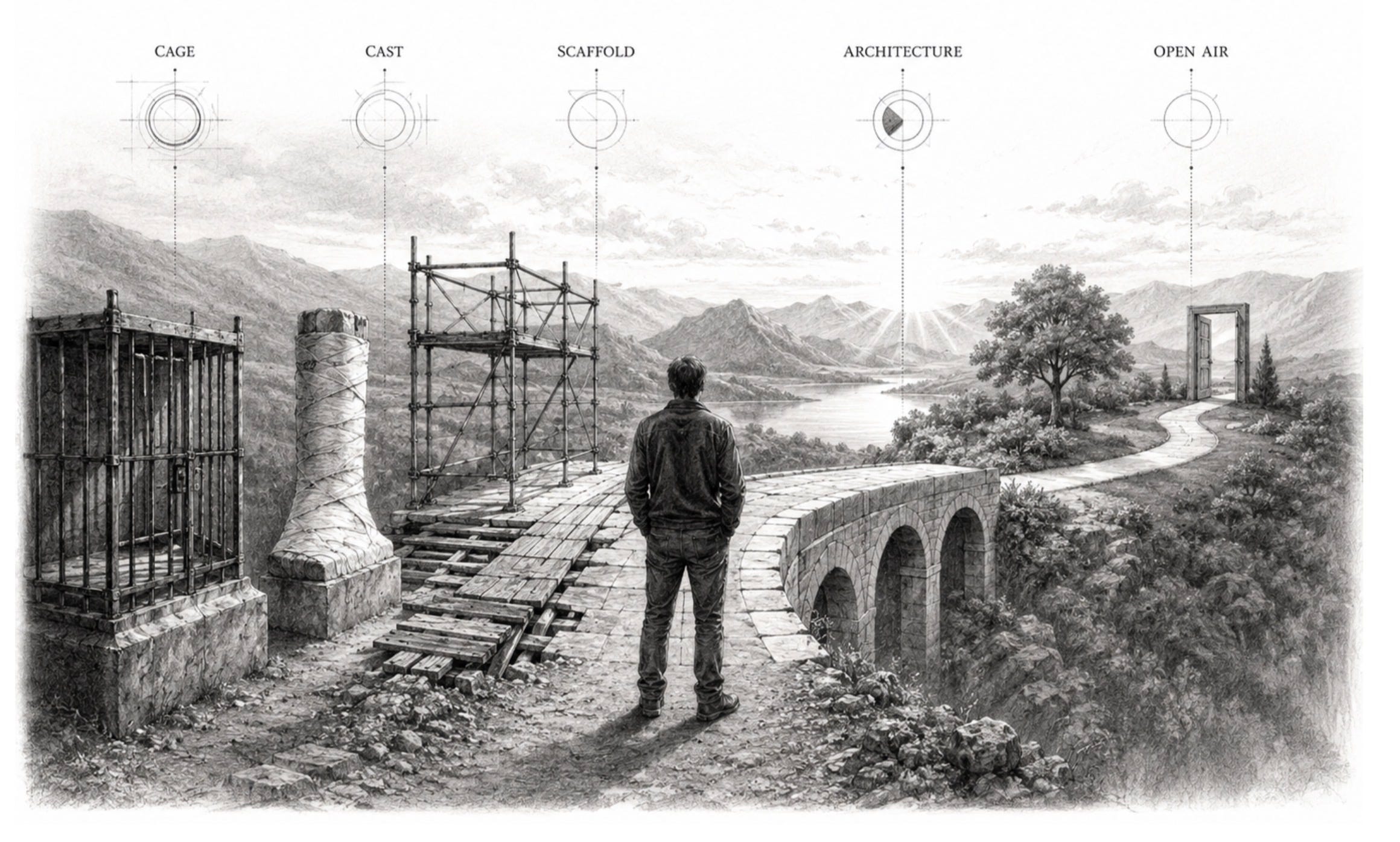
Scaffolding supports a building while it is being constructed. It is never intended to become the building itself.
Perhaps recovery is much the same.
Introduction
Active addiction is a remarkably small space. It is a dim, squalid mental cage where the walls slowly close in until your entire intelligence, your history, and your potential are reduced to a single, exhausting loop of self-negotiation. It feels like an impossible end station. But recovery is not the act of building a safer cage. Recovery is an invitation to step outside into a project that is forever unfinished—the fascinating, sometimes uncomfortable, but deeply exciting journey of discovering who you actually are when the noise finally stops.
1. The Anatomy of the Cage
To understand why a life of long-term recovery must be expansive, one must first look honestly at the nature of the cage it replaces. Active addiction is not merely a collection of bad habits or a series of poor choices; it is a profound narrowing of reality.
For those who think too much—the intellectuals, the high-achievers, the people accustomed to analysing their way through life—the cage is built out of their own cognitive strengths. Your intelligence ceases to be a tool for exploring the world and becomes a tool for managing a crisis. The mind is transformed into a permanent negotiation room. Every morning becomes a calculation: How much did I drink? How much do I have left? When can I start? How do I look? What did I say?
This constant self-negotiation is exhausting. It reduces a highly complex human being with an open history and endless potential into a binary mechanism. You are either managing the presence of the substance or managing its absence. There is no third state. Your world shrinks until it is just you, the substance, and the complex web of lies and strategies required to keep them together.
It is a dim, static certainty. In the cage, nothing new can happen. The intellect is entirely occupied with self-preservation, leaving no room for curiosity, art, or genuine connection. It feels like an impossible end station because the very tool you would normally use to free yourself—your analytical mind—is the one operating the lock.
2. The Emergency Cast (The First 30 Days)
When you are locked inside the squalor of that mental cage, your judgment is compromised. The survival loop has hijacked your logic. Yet, this is precisely when the intellectual mind rebels most fiercely against the traditional remedies.
I know this resistance intimately. I spent five separate, expensive, and ultimately non-productive stints at the Priory resisting the rigid, ceremonial framework of twelve-step recovery. From the vantage point of my intellectual entitlement, the slogans felt like platitudes, the group formats felt like anachronistic rituals, and the lack of nuance felt insulting to my intelligence. I thought I was too complex for a one-size-fits-all program. I wanted to understand my addiction completely before I changed my behaviour.
What I failed to see was that you cannot negotiate your way out of a burning building using a blueprint written by the arsonist.
Today, I view the rigid regime that AA sets for at least the first thirty days in a completely different light. It is not an ideological surrender, nor is it a permanent assignment of identity. It is a medical cast for a fractured psyche.
When a bone is broken, you do not debate the philosophy of the cast; you apply it to hold the limb completely still so the biological healing can begin. The absolute rigidity of the first thirty days—the meetings, the routine, the strict surrender of choice—serves exactly this purpose. It removes the burden of decision-making from a brain that is currently incapable of making safe choices. It creates a hard, external boundary that holds its shape when your internal world cannot.
You do not need to believe everything you hear in those rooms during those four weeks. You do not need to adopt the ceremony as your lifelong religion. You simply need to remain inside the container long enough for the chemical storm to clear, the neurological alarm to quiet down, and the true “I” to stand a chance of taking the wheel.
3. Removing the Cast (Moving Beyond the Scaffolding)
A medical cast is an extraordinary piece of engineering, but no one mistakes it for a permanent limb. If you leave a cast on a healed leg for six months, the bone may be secure, but the muscle beneath it will completely atrophy. You will have traded a fracture for permanent immobility.
The same danger exists in the long-term architecture of recovery. For many people, the lifelong adherence to rigid, ceremonial routines and the daily repetition of traditional recovery formats is exactly what keeps them safe. That is perfectly valid, and it deserves respect. But for others—particularly those who possessed high-agency, independent minds before their addiction—staying on permanent life support eventually ceases to feel like healing. It begins to feel like a continuation of the cage, just with cleaner bars.
When recovery relies exclusively on a “stick” methodology—constantly managing your triggers, blaming your social environment, and treating your character as a permanent biohazard—it shifts the focus back to the disease. It assumes that the goal of recovery is to somehow erase the past.
But neuroscience and human experience tell us otherwise: you cannot unlearn an addiction. Once those neurological pathways are formed, they remain in the brain forever, much like the deeply ingrained muscle memory of knowing how to ride a bicycle. It cannot be unlearned.
For me, I picture this permanence as a door in my head that is never quite closed. Behind that door, there is a shining, alluring light. It is never completely shut, and it never will be. My past relapses happened because I allowed myself to open that door and take just a single step inside—and one step was all it took to send me plunging back down the steep, accelerating darkness of the stairwell.
Moving beyond the scaffolding of early recovery does not mean pretending that door isn’t there. It means changing how you think about it. You do not need a personality transplant, and you do not need to spend your life trying to board the door up in a panic. Instead, you learn to live alongside it. The door remains a permanent landmark—a quiet, powerful reminder of exactly where you choose not to go. You catch a brief glimpse of the light as you pass by, acknowledge its presence, and keep walking forward into the open air.
Conclusion: The Designed Life
To leave the universal scaffolding of the first thirty days behind is not to step into a vacuum, nor is it a license to navigate early sobriety without a map. To do so would be an act of reckless vulnerability. After four weeks, the brain’s hijacked survival pathways are still active, and the door in your mind remains wide open. The addiction is patiently waiting for a lack of structure so it can reassert control.
Moving beyond the initial cast does not mean abandoning a recovery program; it means transitioning from a standard, institutional template to a deliberate, personally designed architecture of support. A planned program remains absolutely non-negotiable for the foreseeable future, but its shape must eventually match the unique contour of your life.
Choosing the carrot over the stick means accepting that this self-designed life will occasionally be uncomfortable. When you stop numbing reality, you have to experience it in its entirety—including the sudden flatness, the irritation, and the sharp bite of honest emotion. But that discomfort is not a sign of failure; it is simply what an un-numbed life feels like. The squalid certainty of the cage promised a predictable, waking death. The open air promises an unpredictable, authentic existence.
You cannot erase the past, and you cannot close the permanent door in your mind. But you can outgrow it. By replacing the destructive velocity of your history with the rich, observant depth of the present—and maintaining the strict routines that keep that depth safe—you turn sobriety from a daily punishment into a fascinating, lifelong journey of self-discovery.
The universal cast gets you back on your feet. But it is the active, deliberate architecture you build next that allows you to walk forward into a future worth living.